Archive for the ‘Spotlight’ Category

Articles

Andrea Watkins: KATH Board Member and H-KY Book Review Editor

In Spotlight on January 17, 2014 by Randolph Hollingsworth Tagged: , , , ,

Andrea Watkins

Dr. Andrea Watkins

KATH-online turns the spotlight on Dr. Andrea S. Watkins of Northern Kentucky University, the 2013-14 KATH Board representative for public comprehensive universities. Dr. Watkins has also recently been accepted as the H-Net Book Review Editor for our own H-Kentucky network – best wishes and we hope her H-Net book review editor training starts soon!

Current school and alma mater/s:

Associate Professor of History at Northern Kentucky University
PhD (1999), MA (1993), and BA (1991) from University of Kentucky

Fields of interest:

Antebellum South, Kentucky History, United States Slavery, Family and Community History

When did you first develop an interest in history?

As the daughter of a historian, I grew up visiting museums, historic homes, and battlefields throughout my childhood.  I remember the 1982 miniseries on George Washington (based on James Thomas Flexner’s Washington: The Indispensible Man) as starting my lifelong interest in our first president, but history really came alive for me at my first visit to Gettysburg in 1986.

How have your interests changed since graduate school?

I still study family relationships in the antebellum south, but my interests now extend more toward the institution of slavery and its impact on families, both white and black.  I also spend a great deal more time researching Kentucky history than I ever imagined I would when in graduate school.

What projects are you working on currently?

I am working on writing a monograph on Robert Wickliffe and his family from Lexington. The Old Duke played a key role in many of the key issues of the antebellum period in Kentucky.  I am also reading and researching the lives of Kentucky women during the Civil War.  The several diaries and memoirs of these women provide an insight into the divided nature of Kentucky citizens during the war.

Is there an article, book, movie, blog, etc., that you could recommend to fellow KATH members?

I have read two recent books about Kentucky that I highly recommend for both the information and their new interpretations of history.  They are Matthew Salafia’s Slavery’s Borderland: Freedom and Bondage Along the Ohio River (2013) and T.R.C. Hutton’s Bloody Breathitt: Politics and Violence in the Appalachian South (2013).

I follow the Twitter feed of the Smithsonian’s National Museum of American History (@amhistorymuseum) because they provide wonderful links to objects, photographs, etc. within their collection.  I find great items that easily capture the interest of students that I can use as a jumping off point for discussions of larger themes.

I also highly recommend the Mount Vernon website (http://www.mountvernon.org/).  There are wonderful short educational pages and videos by historians that I use successfully in online courses and in the classroom when studying George Washington and the eighteenth century.  Students particularly love the six minute video on Washington’s dentures! (http://www.mountvernon.org/georgewashington/teeth/dentures)

Other than history, what are you passionate about?

I like to spend time with my husband, Steve, and our daughter, Rachel.  I enjoy reading mysteries and biographies, and watching television in the evening to unwind.  I enjoy movies and have especially enjoyed the recent Hobbit and Hunger Games movies with my daughter.

Any final thoughts?

I am proud to be a part of KATH and to spend time with other teachers who enjoy history as much as I do.  The humanities as a whole have taken a hit in recent years, but as history teachers we know the value of studying the past to inform and enlighten our present.  I hope I am able to pass on some of the joy and excitement I find in the profession to all those I meet in the classroom and community.

Articles

Spotlight on Megan Mummey, KATH Board Member

In Spotlight on January 6, 2014 by Randolph Hollingsworth Tagged: , , , , , , , , , , ,

Megan Mummey, UK Libraries

Megan Mummey, UK Libraries, 2013-14 KATH Board member

We turn the spotlight now on Megan Mummey, our newly elected Librarian/Archivist Representative on the 2013-14 KATH Board. Ms. Mummey is a Collection Management Archivist in Special Collections at the University of Kentucky Libraries. Here are her responses to our interview questions:

What is your current school and alma mater/s?

Collections Management Archivist at the University of Kentucky; University of Texas at Austin MSIS (2009) and BA in History (2007).

What are your fields of interest?

Archival science and early state history for Kentucky and Texas.

When did you first develop an interest in history?

My interest first developed during my AP U.S. history course in high school. I loved reading our textbook, which was a springboard to other books and from there to my undergraduate degree.

How have your interests changed since graduate school?

My interests have changed significantly. While in school, I studied and wrote on Russian intellectual history, but my interests have changed through my professional archival work in Texas and Kentucky. As an archivist I work with a broad range of primary resources. Currently, I work with records and documents concerning Appalachia, early Kentucky history, military history, and Kentucky public policy. Through processing and providing reference I have gained a very deep and specific knowledge of our holdings.

What projects are you working on currently?

I currently supervise students and staff working on processing a range of material, including civil war letters, the papers of Kentucky education advocate Bob Sexton, early Kentucky broadsides, and the Andrew J. May papers. I just finished working on the W. Jefferson Harris Collection about the saddlebred horse industry in the early twentieth century. I’m also working with a group of librarians and several students on an interactive digital and physical exhibit called “Immigrants in Appalachia”, which will go up in March.

Is there an article, book, movie, blog, etc., that you could recommend to fellow KATH members?

I contribute to the University of Kentucky Special Collections blog Curiosities and Wonders. We post highlights from our collections; announcements about acquisitions and fully processed collections; and different events and exhibits Special Collections puts on.

Other than history, what are you passionate about?

Running after my 18 month old son, cooking, and reading everything I can get my hands on.

Articles

KY Geography Alliance blog

In Spotlight on November 17, 2013 by Randolph Hollingsworth Tagged: , , , ,

Scott Dobler (l) and Amy Murrell Taylor (r) disussing the use of GIS in Kentuky history research

KATH 2013: “Using Geographic Information Systems to Analyze Kentucky Battlefields” with Scott Dobler (left), KY Geography Alliance, WKU

This just in from WKU geography professor, Scott Dobler of the Kentucky Geography Alliance (presenter at the 2013 KATH conference):

The Kentucky Geographic Alliance and National Geographic Education is partnering with H-Kentucky on H-Net <https://networks.h-net.org/h-kentucky> to celebrate Geography Awareness Week.

A series of Kentucky-based maps will be presented to the Kentucky P12 community. Education and content experts will be answering questions from you and your class about the maps and other questions engaged in the series of blogs. Please stop in for some interesting conversations.

The conversation will begin on Monday, and you can access it through the Kentucky Geographic Alliance Blog via the H-Kentucky network. In order to join the conversation on the content presented, first log in at H-Kentucky (create an account <https://networks.h-net.org/user/register>) and then post your comments.

We will also be promoting Geography Awareness Week information via our Facebook <https://www.facebook.com/kygeoalliance> and
Twitter <https://twitter.com/KYGeogAlliance> pages, so be sure to interact with us there as well.

Scott Dobler
Kentucky Geographic Alliance

Articles

Nancy Baird on importance of history

In Spotlight on November 12, 2013 by Randolph Hollingsworth Tagged: , , ,

Nancy Baird

Nancy Baird

Our KATH Spotlight turns to Nancy Disher Baird, retired librarian at the Kentucky Library (now Special Collections Library) at Western Kentucky University.  Ms. Baird joined the faculty of the Department of Library Special Collections in 1975 and is a professor and specialist in Kentucky history.

Josie Underwood's Civil War DiaryHer most recent work is to edit a Bowling Green woman’s Civil War diary – a wonderful publication that helps us see the Civil War from a Kentuckian sympathetic to the Union:  Josie Underwood’s Civil War Diary.

Ms. Baird, Professor Emerita at WKU, has been interviewed several times – see the full array at the KHS “Pass the Word” database. Click here to listen to Lisa Karen Miller’s interview with Nancy D. Baird, June 17, 2013where she talks about the history of the WKU campus, key WKU historians such as Lowell Harrison, and her 35 year career in the WKU library system.

Articles

Spotlight: Jake Gibbs

In Spotlight on October 27, 2013 by Randolph Hollingsworth Tagged: , , ,

Jake Gibbs, Bluegrass Community & Technical College

Jake Gibbs

Turning the focus back to our KATH Member-in-the-Spotlight, this time we present 2013-14 KATH Board Member, Jake Gibbs, who represents Kentucky Community & Technical Colleges. (See past KATH Spotlight articles by clicking here.) Jake has been a Professor of History and Academic Ombud at Bluegrass Community & Technical College since 1988. His graduate degrees, both the MA and MLS are from UK, and his BA is from SUNY Brockport.

Fields of Interest: History of Books and Printing, History of Science, History of Socialism and Anarchism, Irish History.

Interest in history: In high school I never dreamed I’d end up in history. I was mostly interested in science and math. History was memorizing names and dates; easily done but uninspiring. At SUNY Brockport I started out in physics. I took a couple of history classes to fill a requirement and found it way different than high school. I took a few more classes and discovered some exceptional teachers: Kempes Schnell, Susan Stuard and John Kutolowski. While at Brockport I also developed an interest in philosophy and that became my second major. I went to graduate school without a clear idea of what area to study. After fumbling around a bit I found the history of science people, Bruce Eastwood, Eric Christianson and John Scarborough. It was a pretty good fit, bringing together my interests in history and philosophy with my physics training.

After history graduate school I went to the library school at UK for a Masters in Library Sciences (MLS). There I developed an interest in the history of books and printing. I’d always been interested in radical political movements and while working on the MLS discovered the rich tradition of the radical press.

Current Project: After a decade of work I’m nearing completion of a history/bibliography of the Haldeman-Julius Little Blue Books. This series of inexpensive paperbacks was published from 1919-1978. It was designed for self-education for working people. The 2,300 titles cover reprints of great literature, socialist tracts, sex education, science and math works, and how-to books ranging from How to Build a Greenhouse to How to Conduct a Love Affair. The project has been great fun. I’ve examined collections of the books in 22 libraries ranging from Yale to Northridge State, CA and met fellow eccentrics around the country who collect the works of the Haldeman-Julius Company.

Book Recommendation: I read a lot of fiction and occasionally I come across good historical fiction. I think Kevin Baker’s novels about New York City are exceptional. My favorites are Paradise Alley which deals with the Irish Famine and the Draft Riots of 1863, and Dreamland, a story of Jewish immigrant workers that culminates in the Triangle Fire of 1911.

What do I value about the profession: I prefer the life of the mind to the life of the back. When I was young I thought I was destined to a life of manual labor. Teaching sure beats that, in my estimation. I get to talk about what I’ve been reading to a captive audience and the captives seem to have fun. I love to read and it’s wonderful to have a job that requires that I do lots of it and almost all it of my choosing.

Other passions: I am a passionate urbanite. I grew up in northeastern city with a rich ethnic experience. Now I live in a historic Lexington neighborhood. I have a car but rarely use it. I walk to work, the library, YMCA, the movie theater, and various restaurants and coffee shops.

Articles

AHA History Tuning Project

In Spotlight on October 23, 2013 by Randolph Hollingsworth Tagged: , , , , ,

Have you been following the American Historical Association’s Tuning Project? The AHA teamed up with Lumina Foundation to conduct a nationwide, faculty-led project to “articulate the disciplinary core of historical study” and to “define what a student should understand and be able to do at the completion of a history degree program.”

They’ve recently released a new version of its Discipline Core – a statement of “the central habits of mind, skills, and understanding that students achieve when they major in history.” This is the second version created by the faculty director of the project, Anne F. Hyde (Colorado College), who incorporated feedback from last year’s publication.

They have listed six core competencies with 5 or 6 learning outcomes under each competency (http://www.historians.org/teaching-and-learning/current-projects/tuning/history-discipline-core).  According to the AHA Tuning Project faculty, history students can:

  1. Engage in historical inquiry, research, and analysis.
  2. Practice historical empathy.
  3. Understand the complex nature of the historical record.
  4. Generate significant, open-ended questions about the past and devise research strategies to answer them.
  5. Craft historical narrative and argument.
  6. Practice historical thinking as central to engaged citizenship.

If you are teaching a historical methods class this year, take a look at your syllabus and see if your assignments have aligned with the core competencies laid out in the AHA Tuning document.

There is an excellent critique of the document in EdWired – check out “Getting History in Tune” by Mills Kelly (aka @EdWiredMills on Twitter), historian at George Mason University.

If you’ve got some ideas you’d like to share for other Kentucky history educators about the AHA Tuning History Discipline Core, please reply to this post.

For more information, see the project webpage at http://www.historians.org/tuning.

Articles

H-Kentucky has transitioned to the H-Net Commons

In Alerts,Spotlight on October 11, 2013 by Randolph Hollingsworth Tagged: , , , , , ,

H-KentuckyThe Kentucky Association of Teachers of History, the Kentucky Historical Society and the Kentucky Virtual Library came together in 2006 to organize a new Humanities and Social Sciences Network (H-Net) network: H-Kentucky.  The H-Kentucky network focuses on “History, Heritage, and Culture in the Bluegrass State.” Just this week, the H-Kentucky listserv community has moved to the new Web2.0 platform in the H-Net Commons.  Take a look:

http://networks.h-net.org/h-kentucky

In the old listserver, members received via email information about history-related events taking place here in Kentucky, original reviews of books, articles, websites, museums and films that might be of interest to Kentucky faculty and teachers — as well as job announcements. Unlike in the old listserv community, the new H-Kentucky network has many more opportunities to use robust digital media technologies (audio clips, video, image galleries, document sharing) as well as sharing information across multiple networks seamlessly. Users may receive notices via email or via RSS feeds.

We are looking for subscribers who will help create new content.  Here is a list of the different kind of content producer roles for the new H-Kentucky:

  • Subscriber – create Discussion Posts and reply to existing discussion posts (note: as with the old H-Kentucky listserv, all posts require moderation by the editor before appearing on the network).
  • Blogger – these subscribers can also create Blog posts.  Blog posts DO NOT go through the moderation system, so bloggers will be vetted by the editors as an expert on their topic.
  • Contributor – upload files to a network (for moderation by an editor).  On H-Kentucky all subscribers are given this role, but we may want to solicit Lead Contributors to help get projects going.
  • Moderator – can help moderate and publish Discussion Posts submitted to the network – so they will be invited by the H-Kentucky network editors to serve as H-Kentucky Discussion Leaders.
  • Network Editor – can create all types of content, edit their Network, create blogs and dynamic content pages featuring the latest contributions, moderate content, and manage subscribers.
  • Review Editor – using the H-Net Review Management System, organizes a database of reviewers, chooses books to review and moderates book reviews submitted for publishing on H-Review.

Note: a person can have more than one role.

The goal of H-Kentucky has always been to create an online collaborative environment to facilitate communication and the exchange or scholarly and pedagogical ideas among teachers, researchers, scholars, advanced students, and related professionals (e.g. local historians, librarians, archivists, genealogists), all in an open, democratic, respectful and non-partisan manner. H-Kentucky especially welcomes those who are interested in Kentucky, as well as those in any history or humanities field who live and/or work in Kentucky.

Here are some examples of projects our new system could handle.

A Picture or A-V Gallery for H-Kentucky (our own Pinterest!): Creating an A-V Archive
There are two options for creating an image archive in the new H-Net Commons.

  • By Image Category:  We can assign a “category” to any kind of Contribution (image, video or audio clip, document) you would like to appear in the archive then create a dynamic page which will automatically incorporate all images with that category (current and new) in order of most recently added. Once we set up the archive, it will require little to no maintenance since it will be constantly updated whenever an image with that particular category is published.
  • Manually: We can create a new page and embed each selected Contribution into the webpage. We can embed as many items in the page as you like – and in whatever order you prefer.

A Digital Reference Guide for H-Kentucky Networkers: Creating a List of Links
Links are their own content type on the H-Net Commons. You can ask an editor to create a link that includes multiple sources of information about a particular resource that is important to H-Kentucky subscribers.  For example, a link could include both another set of links and a notation about how useful those resources are – a sort of annotated, digital bibliographical entry. If you assign a category to all the links you would like to appear on a single page, then the editor can create a dynamic page which will automatically incorporate all links categorized that way (from most current to oldest entry).  If you want to create a list that is in a particular order or incorporates links published from other networks, then we would need to create a page that embeds each of the links – and think about including sub-titles, images, etc. to take advantage of this kind of design choice.

A Digital Bibliography: Creating a Dynamic Page of Contributions
We can use H-Kentucky webpages to create a series of sources on one single page that pulls together items of a certain category.  For example, we might choose a new category which will be applied to all the sources which will appear in a digital bibliography. For example, categories like “Antebellum Kentucky Source” or “Louisville KY Source” could be applied to selected posts, blogs, contributions or other pages. The main page would then display all the sources in a digital bibliography.  We could even add the bibliography to our Network Menu on the top right of every page.  The only potential downside to this method is that sources will not appear alphabetically – they will appear in order of most recently to earliest published.

For questions about how all this works, please contact H-Kentucky at editorial-kentucky@mail.h-net.msu.edu.  Looking forward to seeing KATH members make this new network work!

Articles

Kentucky History Day 2014

In Spotlight on October 5, 2013 by Randolph Hollingsworth Tagged: ,

NHD theme 2014 Kentucky History Day is a project-based education program that engages students in the process of discovery and interpretation of historical topics. Participation is open to all 4th-12th grade public, private, and home school students. They can choose topics about art history, scientific history and technology, military history, political history, religious history, and almost anything else that sparks their curiosity.

Students are expected to place their project into historical perspective, examine its significance in history, and show development over time. Their projects should also include an investigation into available primary and secondary sources, analysis of the evidence, and a clear explanation of the relationship of the topic to the theme.

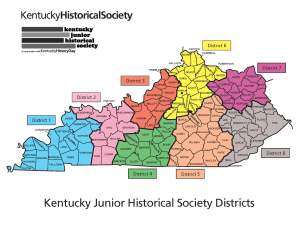
Kentucky state map showing KJHS districts 1-8The competition categories are as follows:

  • Junior (6-8 graders) and Senior (9-12 graders) Divisions
    • Exhibit
    • Documentary
    • Paper (individual only)
    • Performance
    • Website
  • Youth Division (4th and 5th graders)
    • Exhibit
    • Documentary
    • Website

This year’s theme is “Rights and Responsibilities in History” – the national website offers a wide variety of sample topics associated with the theme (http://www.nhd.org/images/uploads/2014_Sample_Topics.pdf).

A district competition (you can download the map here) leads up to the statewide competition at the University of Louisville (April 25-26, 2014).

Regional District Date and Site of Competition
Districts 1 and 2 March 29, 2013; Kentucky Wesleyan University (Owensboro)
Districts 3 and 4 TBA
District 5 March 22, 2013; Eastern Kentucky University (Richmond)
District 6 Date TBD; Northern Kentucky University
District 7 February 22, 2013; Morehead State University (Morehead)
District 8 March 28, 2013; Southeast Kentucky Community and Technical College (Cumberland)


If you are interested in further information regarding National History Day in Kentucky, see the Kentucky Historical Society’s website <http://history.ky.gov/kentucky-history-day-information/>. To arrange a visit from the NHD coordinator in Kentucky, please contact Cheryl Caskey at cheryl.caskey@ky.gov or 502-564-1792, ext. 4461.

Articles

Spotlight: Angela Ash, Owensboro CTC

In Spotlight on August 27, 2013 by Randolph Hollingsworth Tagged: , , , , ,

Angela Ash, OCTC

Angela Ash, OCTC

Keeping the focus on our KATH Member-in-the-Spotlight, this time we present 2012-13 KATH Board Member, Angela Ash, who represents Kentucky Community & Technical Colleges. (See past KATH Spotlight articles by clicking here.)

Current school and alma mater/s:  Assistant Professor of History at Owensboro Community and Technical College; MA 2005 University of Louisville; BA 2003 Brescia University; AA Owensboro Community College

Fields of interest: English Reformation, French Revolution, 19th Century Europe, World War I, Jewish History, Military History.

When did you first develop an interest in history? I remember as a child, my mother bringing home books on the Holocaust and World War II from her bookstore, and my father’s deep interest in the American Civil War also made a lasting impression.  I carried this with me through high school, where my favorite courses were World Civilizations and American History, in the US Navy, where our RDC’s would quiz us on American Naval History, and then in college, where I had amazing History professors like Dr. Marc Maltby for American History at Owensboro Community College, and Dr. Frances Brown for European History at Brescia University.  I knew then, as a college student, that I wanted to devote my life to the study of history, and emulate my professors to the best of my ability with the hopes of connecting with students in the same way.

How have your interests changed since graduate school? In graduate school, my focus was researching the dimensions of the English Reformation, particularly the dissolution of monasteries and the overall impact.  However, after a few years of teaching, reading and researching independently, I have transferred that same passion to military and diplomatic history; 19th century Europe and World War I have been my objects of study for the past few years.  I also have spent much of the time since graduate school improving my teaching – finding ways to make history relevant and exciting to students.

What projects are you working on currently? My current projects include preparing a Constitution Day presentation for my campus on the European roots of the American system of government, participation in a panel discussion and local documentary on the European front in World War II sponsored by the Daviess County Public Library, and recruiting students to sign up for a 2014 summer study course I plan to teach with a colleague, involving a trip to the Czech Republic, Austria, and Poland.

Is there an article, book, movie, blog, etc., that you could recommend to fellow KATH members?  One of my favorite books is a classic – Niall Ferguson’s The Pity of War, and my favorite documentary is the PBS masterpiece “The Great War and the Shaping of the 20th Century.”

What do you value most about the history profession? I value the time I get to spend with the students, and the opportunity I have to help them understand the human story and how it relates to them.  To me, it is a huge responsibility, and every class session is a chance to make the past matter in a culture where what happened “before me” is not necessarily valued.

Other than history, what are you passionate about? My eight year old daughter Gracie tops that list, but I also love to travel when possible, watch old films, study languages (when I can), and listen to music, though my taste is quite eclectic.

Any final thoughts?  I have a favorite quote from Plato that I sometimes share with students – “Only the dead have seen the end of war,” which is rather grim, but drives home an important point about past and present conflict.

Articles

Spotlight: Pattie Dillon, KATH President-Elect

In Spotlight on August 15, 2013 by Randolph Hollingsworth Tagged: , , , , , ,

spotlightModeling our spotlight this time on the new AHA blog’s “Member Spotlight” features, we thought we’d ask questions of our KATH Member-in-the-Spotlight this time. (See past KATH Spotlight articles by clicking here.)

Pattie Dillon

Dr. Pattie Dillon at Rivers Institute workshop on “Picturing America”

Today’s KATH Spotlight focuses on our current KATH President-Elect, Dr. Patricia Dillon. Dr. Dillon is Associate Professor of History at Spalding University and is currently serving as the Interim Chair of the School of Liberal Studies.

Current school and alma maters: faculty member at Spalding University since 2003; PhD, Mississippi State University; MA, University of Central Florida;  BA, University of Florida

Fields of interest: Civil War and Reconstruction; Jim Crow era; 1960s America; gender in American history; oral history.

When did you first develop an interest in history? As an undergraduate sociology major, my interest in history did not really develop until I started graduate school (where I planned on majoring in education) and enrolled in a Western History class with Dr. Shirley Leckie. Her ability to breathe life into historical figures, to enliven the past and illustrate how historical events shape the present ignited my passion for historical research and teaching.

How have your interests changed since graduate school? While I still treasure spending solitary time in archives, losing myself in the past researching letters, diaries, and other primary sources, since graduate school I’ve focused more on exploring the Scholarship of Teaching and Learning (SOTL) and Interdisciplinary studies. SOTL research has improved my pedagogy and connection to my students, helping me to ignite their passion for history, while Interdisciplinary studies has enhanced my ability to weave together past and present by exploring historical events through myriad disciplinary lenses.

What projects are you working on currently? With my colleagues in the School of Liberal Studies at Spalding, I continue to explore interdisciplinary teaching and research methods. I also hope to start an oral history project in the  next few years, working with the homeless population in Louisville’s downtown area.

book coverIs there an article, book, movie, blog, etc., that you could recommend to fellow KATH members? I recommend Helen Fox’s revised edition, “When Race Breaks Out”: Conversations about Race and Racism in College Classrooms. With its insightful historical and contemporary analysis of racial issues, coupled with concrete classroom examples, I’ve relied on this text numerous times as I’ve prepared lectures and navigated important, yet oftentimes difficult, classroom discussions.

What do you value most about the history profession? I value history as the thread that weaves the fabric of our collective consciousness. It helps us to explore our humanity and interconnectedness.

Other than history, what are you passionate about? Animal rescue. I believe the way a community cares for neglected and abandoned animals influences how they care for each other.